Maids and Meetings

Hey all!

It’s been two weeks! I hope you’re all doing well.

Sorry for my delayed entry: I spent most of last week recovering from the presentations that I delivered during the week prior. During my week off, I binged Netflix, drank hot tea, and read a few research-related books that I’ve been trying to work into my project. As for this past week, I spent a lot of time reframing my dissertation, chronologically and conceptually. I’ll get into that a bit as I work my way through my daily recaps below!

On Sunday, I woke up at 5:00AM to Skype into my panel at the Association for Asian Studies Conference in Denver, Colorado. While I expected to be overwhelmed by the time difference between Japan and the United States, I was actually very comfortable with my performance. My paper explored how actors in Japan’s various spheres of access-making (physical, educational, vocational, technological, informational, and consciousness-based) currently face significant domestic and international pressures that prevent them from effectively communicating with one another and creating inclusive systems. It argued that crowdsourcing technologies and social media provide potential solutions to these problems by empowering many (but not all) of the nation’s stakeholders and allowing them to share their experiences and opinions with each other. Recognizing the limitations of such technologies and services, I also pushed for diversity in development so as to accommodate the broadest possible range of users. Esoteric description aside, I think that my presentation was fairly well-received and I thoroughly enjoyed the Q/A for my panel, which focused on disability in Japan. My co-presenters, Frank Mondelli and Yoshiko Okuyama, gave interesting talks on ‘technolinguistic poeisis’ for persons with D/deafness and a budding genre of ‘tojisha manga.‘ Our panel chair, Karen Nakamura, and discussant, Carolyn Stevens, offered insightful commentary on each paper and held the room on the edge of their seats. All-in-all, it was a great panel, and a major win in my book as organizer.

On Monday, I spent some time reflecting on the work that I read last week on blindness and infectious diseases in prewar Japan, ultimately deciding that I would shift my project back in time fifty years from the end of World War One (1918) to the start of the Meiji Period (1868). The reasons for this shift are myriad, but the new framing opens up many possibilities for additional research and conforms to a chronology that is perhaps more legible to readers familiar with Japanese history and politics. After plotting out the narrative structure of my new dissertation model I needed to blow off some steam, so I went to the movies to see Captain Marvel. It was a good flick, maybe 7/10 stars?

On Tuesday, I traveled to Kanda from my apartment in Odaiba to meet with Ota Shuhei, a sixty-one-year-old activist with cerebral palsy. Mr. Ota lives in Tokyo and works as the secretary of the Liaison Council for Protecting the Livelihood of Persons with Disabilities 障害者の生活保障を要求する連絡会議(障害連). The Liaison Council was founded in 1976 by a group of persons with disabilities who were connected via community associations and alumni networks of schools for the disabled. Over the next twenty years, members of the Liaison Council campaigned for the reconstruction of Japan’s transportation infrastructure, paving the way for the enactment of the Barrier-Free Transportation Law in 2000. Aware of the Liaison Council’s background, I was truly anxious to meet Mr. Ota. Our interview took place in the central office of the Liaison Council; a space shared by DPI Japan. Mr. Ota and I spoke about his involvement with the Green Grass Society during the 1970s and his efforts to establish inclusive facilities for disabled persons during the 1980s and 1990s. We also touched on a wide range of miscellaneous topics, from religion and philosophy to sake and beer. It was a great experience, and I look forward to seeing him again soon!

On Wednesday, I decided that I needed a break so I took most of the day off to watch Netflix and relax. Never one to procrastinate, I started to transcribe my interview with Mr. Ota during the afternoon. For those unaware, transcription can be a long and unwieldy process, especially if your interview is several hours long, conducted in a foreign language, and marked by points of clarification due to vocal disabilities. Still, I somehow managed to get everything down on paper before the day’s end, so that was a decent accomplishment in my opinion. By the end of the day, however, I wasn’t feeling all that great, so I called a doctor to schedule an appointment for the following morning.

On Thursday, I saw my doctor, who told me to rest and take it easy for a day or two. Indeed, I took another day off sans a couple of Skype calls with my dissertation advisors, Jolyon Thomas and Ayako Kano. Through my conversations with Dr. Thomas and Dr. Kano about the new chronological and conceptual framing of my dissertation, I received some valuable feedback about how I ought to proceed. While I’m still grappling with that feedback and its consequences for the data I’ve gathered so far (alas, it appears as if lots of things that I had hoped to include will have to be cut), I’m optimistic that I’ll find a way to move forward before too long.

On Friday, I woke up early to Skype with a dear friend and fellow activist, Noah Ohashi. Noah is currently working on his Masters in Disability Studies at the University of Illinois at Chicago (UIC). He has had a very interesting upbringing, bouncing back and forth between Japan and the United States. While I won’t give out too many of Noah’s persons details here, I’ll say that he has multiple disabilities and identity factors that collectively create a very unique experience of accessibility for him. I enjoyed talking with Noah about his experience and discussing some of the most serious issues facing persons with disabilities in Japan and the United States today. Among the issues we discussed was media representation and involving persons with disabilities in media production. Noah is uniquely qualified to speak about that field as he has worked as a correspondent on disability at NHK for several years now. After finishing my call with Noah, I gathered my things and ran out the door for an appointment in Akihabara. Well, I say an appointment: what I mean is that I got together with Patrick Galbraith, a leading expert on Japanese popular culture and longtime friend, and went on a Maid Cafe crawl. In search of Akihabara’s most accessible maid cafes, Patrick and I walked around for a couple hours, documenting the (lack of) accessibility of venues around the city. My full report will be published as an article at some point in the coming weeks, so stay tuned!

On Saturday, I left for a meeting with Josh Grisdale of Accessible Japan, which took place at my old stomping grounds in Mizue. For some time, I’ve been acting as an impromptu consultant for Accessible Japan, and I was happy to lend my voice to a conversation about the companies’ future. There’s not too much I can disclose at this point, but exciting things are in the works. Trust me!

And finally, I headed out into Yokohama earlier this afternoon to view the cherry blossoms and enjoy a day of rest and relaxation before hitting the books again tomorrow at the National Diet Library.

It’s been a busy week, but I’m starting to realize they all are when you get to this stage. As always, thanks for reading, my friends. More to come next week!

Becoming a Public Scholar

Hello everyone!

This week has possibly been the busiest out of my entire time in Japan so far.

On Monday, I started preparing for a lecture that I was asked to give to the Disabled Peoples’ International (DPI) Working Group on Asia about accessibility in developing countries. Drawing on my personal experiences as a wheelchair user in Japan and the United States, I’ll identify how disconnects arise between local, national, international, and transnational constructions of accessibility. I’ll emphasize how those disconnects can create problems for persons with disabilities by restricting opportunities for education, employment, and other forms social participation, calling attention to the importance of collaborative design in creating accessible systems. My lecture is still a work in progress, but I suspect that it’ll turn out alright in the end. Thankfully, its not until early April, so I have some time to let it marinate before I need to finish things up. Taking advantage of some of that time, I continued my research on colony formation and patient movements during the postwar period on Monday afternoon.

On Tuesday, I left my apartment early to attend a meeting of the Tokyo Friendship Society of the Deafblind led by Ms. Akiko Fukuda (東京盲ろう者友の会). Ms. Fukuda and I have met on several occasions before. I’ll refrain from giving out too many of her personal details here, but suffice it to say that Ms. Fukuda has led a very interesting life up until this point. She is deafblind and also uses a motorized wheelchair to get around. Ms. Fukuda communicates using Japanese and English, and she is also fluent in multiple forms of sign language. It was extremely interesting watching Ms. Fukuda facilitate the meeting, which was attended by around thirty people. Among the attendees were several interpreters and many individuals with disabilities: visual, hearing, mobility, and otherwise. Each person with a disability had their own degree of impairment and mode of communication, making for a truly unique set of interactions. I was fascinated watching the interpreters translate Ms. Fukuda’s exploration of the topic of the day (universal design) as well as the self-introductions of each person in the room. Still, I was even more awestruck by my own biases and naïveté in conversation. For the first time in my life, I was in a situation where I not only had to announce that I communicate via spoken word, but also had to figure out how to explain that information to individuals who might not be able to comprehend it otherwise due to their sensory impairments.  While my advisor at the University of Tokyo is deafblind, our conversations have always been contextually mitigated: I knew he was deafblind, and he knew I wasn’t, so we had a predetermined mode of communication. That was not so at this meeting, where I encountered strangers about whom I knew very little. It was an eye-opening experience for me, and one that I hope to take forward and apply to my work in the future. Indeed, I was so exhausted from thinking about the scholarly implications of my experience that I decided to take the night off on Tuesday and go out to see the most recent Spiderman movie. It was really good, and I’d highly recommend it to any/everyone interested.

On Wednesday, I traveled to the University of Tokyo to participate in a joint meeting of the research labs of Dr. Satoshi Fukushima (my advisor) and Dr. Shin’ichiro Kumagaya. At the meeting, I delivered a two-hour presentation about my dissertation research in Japanese. While I think that I may not have effectively communicated some of the finer details of my dissertation (which covers one-hundred years of policies and movements related to disability in Japan), the overall message rang clear and I received praise from the twelve individuals in attendance. My advisor was particularly pleased with my framing of the 2020 Olympic and Paralympic games as a prism through which we can understand the past, present, and future of accessibility in Japan. Dr. Kumagaya, for his part, was interested in my decision to emphasize the present condition of accessibility and encouraged me to be more explicit about my framing in future presentations. I’m truly grateful to everyone who attended that meeting and gave me insightful feedback, which I hope to use to continue developing my project. After finishing my presentation and meeting with my advisor for a few minutes in his office, I dashed toward the station and caught a train to the center of Tokyo, where I attended a practice session for my TED talk. The talk took place yesterday afternoon: I talk about it in greater detail below.

On Thursday, I traveled to Mitaka to meet up with Ms. Fukuda once again. This time, Ms. Fukuda invited me to attend a party at her house along with four other motorized wheelchair users and five caregivers. It was the first time that I’d seen more than two wheelchair users fit into an apartment in Tokyo, let alone five! Despite being cramped for space, we somehow managed to fit everyone in and had a great time talking about our interests and experiences. A few brief notes about our conversation:

1) Despite the fact that our ages differ drastically (27, 33, 41, 59, and 94) and we have different conditions, we found that we have lots in common. For instance, we all have problems with our bathrooms that have required us to significantly remodel, renovate, and customize our homes.

2) It was really interesting to hear about how structural barriers in the Japanese education system opened up new opportunities for some of the guests. For instance, one partygoer told me that she was unable to attend regular school due to a lack of accommodation and therefore attended an aftercare program where she learned English, Korean, and French. That she learned foreign languages (and is now fluent in them) because of her isolation from mainstream education is endlessly fascinating to me.

3) I asked my new friends about how Japan ought to proceed if it is to become accessible. Their answers can be summarized as follows: no matter how many laws we enact or policies we create, Japan will not become accessible if the will to enforce those laws and policies is not present. Indeed, the existence of welfare actors and objects (caregivers, wheelchairs, etc.) means little without proper guidance, training, and support. It is often the case that people with disabilities actively refuse assistance from caregivers despite a real need as accepting help from those with improper training can pose an even greater risk than failing to receive any. Scarcity of resources and constant turnover of caregivers makes this a real problem that Japan as a nation has yet to address.

On Friday, I headed to the House of Representatives of Japan to attend a lecture series about cohabitation of persons with disabilities and those without in workplace settings. That the lecture took place in the building of a government that has recently admitted to misreporting employment statistics of persons with disabilities for the last forty years was not lost on those in attendance. Still, the general air was one of positivity and discussion centered on ways of moving forward with workplace integration. The speakers emphasized the importance of capitalizing upon the unique perspective that persons with disabilities can bring to the workplace: how they can accomplish certain tasks that able-bodied users cannot precisely because they are disabled. Emphasizing the value of disabled laborers was of critical importance, as historically that value has often been overlooked in Japan. Indeed, persons with disabilities have often been understood as lacking the qualifications necessary to pursue various kinds of jobs: a condition that is usually attributed to the historical unavailability of education, welfare, and other social services. The transformation of persons with disabilities from “workers with difficulties” to “workers with unique skills” will likely usher in a new kind of economy for Japan, but what will that economy look like? How will it intersect with other global markets? And who else might be affected by it? These philosophical questions remained unanswered, but they drove me to think about the issue in greater detail. Unfortunately, I didn’t have too long to think as I had to rush back to Odaiba to meet with a dear friend, Patrick Galbraith. Patrick and I spent the evening drinking sake and talking about our shared love of anime and manga as well as the state of Japanese academia. He gave me some great advice regarding how I ought to move forward with my job hunt, and for that I’m truly grateful.

On Saturday, I ran out to Roppongi to attend the final rehearsal for my TED talk. For the first time, I got on stage and had the chance to recite my lines while manipulating my PowerPoint. As fate would have it, the auditorium lost power around halfway through my presentation, and I found myself rather off-kilt for the remainder of my speech. Unfortunately, I did not have time for a repeat performance as the remaining time had been blocked out for the other speakers. Still, I wasn’t going to complain, as I was confident with my presentation on the whole. After all, I’d given it many, many times up until that point at home and at informal rehearsals. I sat in the audience for a while and watched the other speakers before running back to Odaiba for yet another dinner meeting. This time, I sat down with Christa Mullis, a masters student at Hiroshima University researching comparative education (history and method) for persons with autism in Japan and the United States. Christa and I spoke in great detail about our respective research interests and overlapping experiences. As it turns out, we both studied abroad at Sophia University through CIEE and know many of the same people. I wish Christa nothing but the best for her project and hope that she finds her way back to Tokyo at some point in the near future.

On Sunday, I woke up early, donned my suit, hopped a taxi, and headed back to Roppongi to attend the TEDxFulbright Tokyo conference. The event featured speakers from a wide range of backgrounds and disciplines: academics, politicians, media specialists, and so forth. Presentations were equally diverse, covering issues related to the construction of race, gender, and disability, as well as matters pertaining to immigration, urban design, and technical innovation. Uniting all of the talks and speakers was the conference theme, “Connect the World.” The event was truly wonderful, and I cannot express how grateful I am to the organizers for allowing me to take part. My speech, which focused on the importance of crowdsourcing technologies for creating accessibility, will be uploaded to Youtube at some point in the future. I’ll share a link on this blog as soon as it is available. For now, I’d like to thank the organizers, as well as all of my co-presenters, for their hard work and dedication in making the event a great success: not just for me, but for the hundreds of audience members in attendance. I’m sure that the event was just the beginning of a much larger conversation about the future of the human race, and that it will act as a catalyst for realizing participants’ respective visions of a more benevolent and inclusive world. As I said in my speech, the TED venue provides a great opportunity for speakers and audience members (in person and/or online) to learn how to transform their respective barriers into possibilities. I hope that everyone does their best to capitalize upon that opportunity and work to create a better future.

Today, I stayed home and rested from a very busy week. Indeed, I have more plans starting tomorrow, so I needed a day off.

As always, thank you for reading, everyone. Stay tuned, as I’ll have more updates next week. Cheers.

House Party at Ms. Fukuda's
House Party at Ms. Fukuda’s
55615855_10157283042407650_7303272637633921024_n
TED Talk (Photo Credit: Yuriko Kon)

Dissertation Defense (2 Years Early)

Hello all!

This past week has been filled to the brim with prep work for the coming two. I’m supposed to deliver at least three major presentations before the week of the 25th, so we’ll see how that goes!

On Tuesday, I made my way through John Dower’s Embracing Defeat (for the fifth time) to find citations and add some context to the second chapter of my dissertation. I also spoke with my friend Josh Grisdale of Accessible Japan about some exciting opportunities for future collaboration and met up with Dr. Michael Gillan Peckitt of Osaka University. Dr. Peckitt has written extensively about his experiences living in Japan as an foreigner with cerebral palsy. I greatly enjoyed our conversation, which touched on numerous aspects of disability history, policy, and activism, as well as educational and employment opportunities. I suspect that my conversation with Dr. Peckitt was only the beginning of a much larger dialogue, and I look forward to its continuation over the coming months.

On Wednesday, I spent much of my day preparing my script and powerpoint for my upcoming TED talk on Sunday, March 17th. After ten or so trial runs, I felt relatively comfortable with my materials and did not need to look at them to get my point across. To put my training to the test, I attended a group rehearsal session on Wednesday night, where I presented alongside Haruko Akatsu (the Dean of Medical Education at IUHW) and Keimi Harada (former mayor of Minato City in Tokyo, Japan). I learned a great deal from the feedback I received after my presentation, and have since incorporated many of my audience’s suggestions into my presentation. One of the most important lessons I learned was about my framing of Japan as a space of (in)accessibility. As a scholar of Japan, I’ve been trained to treat the island nation in relative isolation from the rest of the world, focusing on particular idiosyncratic behaviors and patters: after all, my analysis has to start somewhere. However, this framing of Japan as a space of problems (and solutions) unintentionally distracted my audience from my larger points about the global implications of access making. To correct for such distractions, I’ve since added in a lot of explicit comparisons and theorization of access at local, national, and international levels of analysis. I have another trial run scheduled for Wednesday, so fingers crossed!

On Thursday, my advisors at the University of Tokyo (Dr. Satoshi Fukushima and Dr. Shin’Ichiro Kumagaya) asked if I would be willing to deliver a talk at their joint research meeting this coming Wednesday, March 13. While short notice, I was quick to agree as I’ve yet to have a chance to share my dissertation research with them and their students in a structured setting. I was surprised to learn, however, that my talk was expected to be around two hours in length: one hour of lecture and one hour of Q/A. I wasn’t going to let the length of my talk bother me, however, and I immediately set out to put together materials. By Friday night, I had converted my dissertation prospectus (10 pages) into an easy-to-read outline (5 pages in Japanese) and put together an eighty slide PowerPoint. My talk will be conducted in Japanese, and is in many senses a trial run for my eventual dissertation defense. While I’m still more than two years away from my defense date, I hope to use my talk as a chance to sharpen my presentation skills in Japanese and gain feedback about sources/archives that I’ve yet to tap into (or haven’t tapped into enough).

On Friday, I supplemented my preparation for next week’s talk with work on another presentation that I will deliver on Sunday, March 24th. On that day, I’ll be Skyping in to the Association for Asian Studies at around 5:00 AM to deliver a lecture on “Violent Accessibility” and solidarity trends in Japan’s disabled communities. My lecture is part of a larger panel on Disability in Japan that I put together, which will also feature talks and commentary by Karen Nakamura, Carolyn Stevens, Yoshiko Okuyama, and Frank Mondelli. I really can’t wait!

After finishing up my preparation for both presentations (and having already completed my preparation for my TED talk), I decided that I would go out and get a cup of coffee at the mall. It was already late at night, and before I knew it the mall literally closed around me, shutters and all. While the coffee shop I was in kept its back door open, that door had stairs and I was unable to leave. Panicking, I ran to tell the store manager, and he ran outside to get a security officer to re-open the shutters and let me out. Unfortunately, I was swept away by the moment and forgot my wallet in the coffee shop! I realized around five minutes later and quickly turned around, hoping to catch the security guard before he ran back inside. By this point, it was close to 11:30 PM and it was raining outside. I was physically and mentally exhausted, but I wasn’t going anywhere without my wallet. Thankfully, I found someone to go get the security guard, and was relieved to discover that they’d already recovered my wallet and kept it in the lost and found. Thank god that all of my credit cards and cash remained untouched. Ah, the safety of Japan!

Yesterday and today, I spent a great deal of time digging around the Disability Information Resources System (DINF) maintained by the Japan Society for the Rehabilitation of Persons with Disabilities (JSRPD). There are decades of articles and untapped materials there for me to look at, so I’ve only just begun to scratch the surface. Still, it’s been exciting work, and I’ve already found a lot of exciting things. For instance, I stumbled on photos of Helen Keller from her 1947 visit to Japan! To build on those findings and close out my week, I had dinner with Dr. Yoshiko Okuyama of the University of Hawaii this evening. Dr. Okuyama and I spoke about disability and tojisha manga as well as my own research on the history and politics of accessibility. Our conversation will certainly continue, as we’ll be presenting together on the 24th!

Believe it or not, this has been my ‘rest week.’ Starting on Tuesday, I have major plans each day that blow this weeks’ activities out of the water. At least I feel productive!

More soon, friends. For now, take care!

Screen Shot 2019-03-09 at 3.22.01 AM
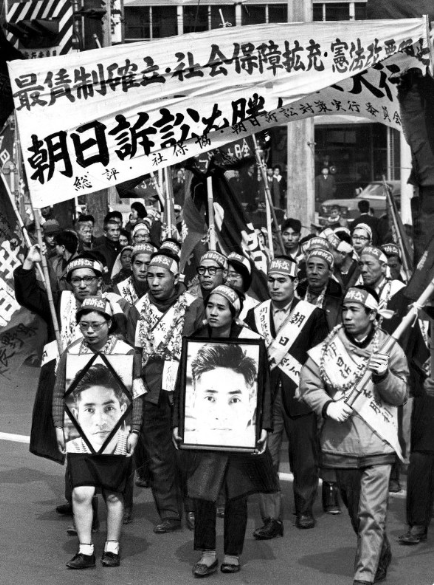
Protestors from the “Asahi Lawsuit,” one of the first ‘right to life’ cases brought before the Japanese Supreme Court in the late 1950s. The case centered around conditions in national sanatoria. I discovered this picture in the DINF archives.


Meetings and Memoirs

Hello all!

I’ve had a fairly exhausting week, but I managed to accomplish a lot!

On Monday, I went to the University of Tokyo’s hospital for my monthly check up. As usual, the department ran several hours late, and I was forced to wait it out in a room full of roughly one hundred people with various unknown illnesses. As a person with (medically induced) immunodeficiency, I always find the prospect of waiting in a room full of potentially sick people daunting: the Japanese public healthcare system certainly doesn’t help allay my fears. Thankfully, I was eventually seen by my cardiologist and given a clean bill of health alongside a six-week supply of medication. By the end of the eight hour ordeal (from 8AM until 4PM), however, I’d lost my capacity to focus on work, so I decided to call it a day.

On Tuesday, I began making inquiries about the possibility of extending my visa. My current “Cultural Activities” visa is due to expire at the end of August, and I wanted to make sure that I have plenty of lead time to extend it in case anything goes wrong. I reached out to Ritsumeikan University and the University of Tokyo, eventually learning that the latter has an internal consulting service. After an exchange of e-mails back and forth with that service, I received a list of necessary paperwork and forms to fill out in order to process my extension request. I began to fill out those forms, which I showed to a representative from the consulting firm on Thursday. For now, it looks like everything is in the clear (although I cannot apply for my extension until mid-May). Still, I’d rather be safe than sorry, and I’m glad that I started the process sooner rather than later.

Also on Tuesday, I had the chance to Skype with Bryan Lowe of Vanderbilt University (soon to be Princeton University!) Bryan and I have met on a couple of occasions, and I find his work on purity and scribes in Nara Japan to be incredibly useful for my own work on religion and disability. Bryan and I took the opportunity to discuss my project on the relationship between defilement and access in medieval Japan, and he was even so kind as to send me a list of sources to check out. Bryan, if you’re reading this, thanks so much!

On Wednesday, a technician came out from my ventilator company to inspect the borrowed unit and ensure that my current settings are adequate (they are). After he left, I dove straight in to Tateiwa Shinya’s new book on patient movements in postwar Japan. As always, I found Tateiwa’s work really insightful, and his extensive bibliography gave me some ideas for the second chapter of my dissertation. I had to shelve those ideas for the time being, however, as I had a meeting with my scholarship administrators at the Japan Foundation. The meeting went swimmingly: I had a chance to update my handlers (who are really more my friends) about my current research and its connection to my activism and daily life. Although I found a soft ending point for our conversation, it seemed as if everyone wanted it to continue. Indeed, I suspect that I’ll have a chance to pick it up again at some point in the near future in the form of a public-facing lecture at the Japan Foundation headquarters.

On Thursday, I dropped in at the University of Tokyo’s Barrier-Free division to meet with the secretary for my department. We discussed many things: my living situation, visa status, career prospects, and, of course, research developments. What I thought would be a short ten minute conversation turned into a two hour dialogue. I certainly wasn’t complaining, however: if there’s one thing I like, it’s talking about accessibility! In any case, I had to cut our talk short to attend a prep session for the U.S.-Japan Collaboration on Disability and Self-Advocacy in Higher Education (a workshop which is scheduled to take place this fall in Tokyo). The meeting was attended by many familiar faces, including but not limited to Heike Boeltzig, Hiroya Banzono, Shin’ichiro Kumagaya. While I can’t go into too much detail about the contents of the meeting, it’s safe to say that we discussed a great many things related to disability advocacy and representation.

On Friday, I returned to my historical dissertation research by turning to memoirs of sanatoria directors and administrators in Japan which recount their experiences during the 1940s and 1950s. Those memoirs were particularly interesting when viewed in light of the Ministry of Health’s A History of National Sanatoria, which provided a structural  overview of the system in which their principle actors lived and worked. Without going into too much detail, the literature I was reading illustrated how the experiences of sanatoria administrators, like those of their patients and clients, were not at all uniform. Each administrator had to negotiate a unique set of circumstances, informed as much by practical and economic concerns as moral and civic responsibility.

On Saturday, I woke up early and headed out to Saitama (around a two-hour train ride from my current residence) to attend the final lecture of two giants in the field of Universal Design in Japan: Takahashi Gihei and Kawauchi Yoshihiko. Both professors are due to retire from Toyo University’s Department of Human Environmental Design next month after long and successful careers. I’ve learned a lot from both Takahashi-Sensei and Kawauchi-Sensei during my short stay in Japan, and I’m sure that I’ll continue to learn from them as I work through my dissertation. For now, I wish them nothing but the best and hope that their transition toward (additional) consulting work goes smoothly.

On Sunday, I spent the majority of my day designing a PowerPoint presentation for my upcoming TED talk (to take place in Tokyo on March 17th). As always, the design process took several hours longer than I anticipated because I’m incredibly picky about the images and effects that I use. Nevertheless, I was happy with the end result, and I suspect that it’ll go over well when I give my talk. I suppose I’ll have a chance to find out, as there are several scheduled practice sessions between now and then.

Today, I conducted some research into the formation of Japan’s laws and policies related to the education of children with disabilities in the postwar period: specifically, those related to children with intellectual and psychiatric disabilities. My research was mainly focused on documents produced by the United States Education Mission to Japan and the Committee of Japanese Educators. After working for a while, I ran out to Toyosu to walk around the mall and take a much-needed break. There, I met up with Nathan Hopson, one of my senpai from Penn who currently teaches at Nagoya University. Nathan and I discussed our respective research projects at length as well as the costs and benefits of job-hunting in Japan and the United States. I learned a lot from him, and I appreciated how broad and deep our conversation was. Looking forward to talking more in the future, Nathan!

That’s all I have for now, everyone. This coming week also promises to be a busy one, with daily meetings and dissertation work. As always, thanks for reading and stay tuned!

(I don’t have any great photos from this week, so here is the last slide of my TED talk!)

TED Talk Final Slide

Archives and Acquaintances

Hello all!

This week was very much a “nose to the grindstone” affair. For the first time in a couple of months, I spent at least 3 hours each day digging through [digital] archives and books gathering information for the second chapter of my dissertation, which focuses on the reconstruction of the Japanese welfare system in postwar Japan (1945-1960) and its effects on persons with disabilities. I also attended a forced sterilization trial at the Tokyo District Court which heavily tied in with that research, as it centered around the now defunct Eugenics Protection Law (1948).

On Monday, I Skyped with a dear friend of mine and fellow disability studies PhD student, Frank Mondelli, before diving in to a host of digital archives. Among the archives I searched were the U.S. State Departments Records on the Internal Affairs of Japan, SCAP’s Summation of Nonmilitary Activities in Japan and Korea, the National Diet’s digital records archive, and others. I was rather displeased (but not at all surprised) to find relatively little mention of disability in the above English language sources. As it turns out, the Allied Powers were apparently more concerned with democratization and demilitarization than disability itself. Indeed, they seem to have paid little attention to the consequences of democratization and demilitarization on disabled populations (sans veterans, whom they attempted to deprive of special privileges.)

On Tuesday, I attended a forced sterilization trial at the Tokyo District Court House. The plaintiff, Saburo Kita (a pseudonym), came forward seeking compensation for his forced sterilization under the Eugenics Protection Law, which occurred approximately sixty years ago when he was 14. Representatives from the Japanese government argued that Mr. Kita  was not entitled to compensation as his sterilization occurred more than twenty years ago (the statute of limitations) and questioned why Mr. Kita did not attempt to seek reparations up until this point. Mr. Kita replied that he was unable to seek reparations as he did not receive a proper explanation regarding the surgical procedure that he was forced to undergo. He also indicated that he was unable to vocalize his grievances in an environment where eugenic ideology was actively taught in public schools (this was true in Japan at least until the abolishment of the Eugenics Protection Law in 1996) and felt significant shame about his inability to bear children. So much so, in fact, that he did not tell his wife until shortly before she passed away.

The trial was interesting for a number of reasons. That Mr. Kita is finally able to come forward with his claim seems to suggest that Japan’s atmosphere is changing with regard to attitudes toward eugenics and disability. But is this change a function of the passage of the Law for the Elimination of Discrimination Against Persons with Disabilities (2016)? The preparations for the upcoming Olympic/Paralympic games in 2020? The nation’s aging population, declining birthrate, and shrinking workforce? Perhaps some combination of all of these factors and then some? What does Japan’s shifting landscape mean in light of routine reports of violence and abuse in the media and tragic events like the Sagamihara Stabbings of 2016? There’s a lot to unpack here, that’s for sure.

What I was most struck by was the attendance and procedure at the trial (and after it). Before the trial began, the presiding judge went out of his way to call attention to the courtrooms’ accessibility features. He noted that a sign language interpreter was present in the room, and that the room was equipped with two video monitors for presentations. The judge also pointed out that there were several wheelchair spaces (three of which were occupied), and that it was ok to move around and leave the courtroom as necessary for comfort. I was delighted to see such treatment of accessibility, especially at a trial centered around disability issues. I was less delighted, however, to find out that a debriefing session organized by a group in support of Mr. Kita was not accessible to me. The venue was some distance away from the courtroom, and it had a rather steep slope outside that prevented me from entering. Alas, it seems that the group changes venues after each hearing. Maybe the next one will be more suited to my needs!

On Wednesday, I read a bunch of literature related to the establishment of the Social Welfare Industry Act (1951) in Japan. The act allowed the Japanese government to offer subsidies to private healthcare facilities and integrate them into a national healthcare network. That network would help administer protections, treatments, and services as indicated by a slew of healthcare laws passed in the immediate postwar, including but not limited to the Public Assistance Act (1946), the Child Welfare Act (1947), the Eugenic Protection Law (1948), the Law for the Welfare of Physically Handicapped Persons (1949) and the Mental Hygiene Law (1950). The passage of these laws forms a linear narrative of healthcare in Japan, which is punctuated by the activities and protestations of various disability movements. In the second chapter of my dissertation, I trace the activities of those movements to illustrate how they found solidarity with one another (or not) and paved the way for a new age of disability kinship in the 1960s and 1970s. I’m still in the researching stage, but it’s coming along nicely!

On Thursday, I had a visit from a medical supply retailer about buying a new hospital bed. I’ve been renting my current bed for a while now, and while its nice and everything it’s rather costly to do so. In fact, it’ s probably cheaper for me to just buy a new bed (with the help of my national/disability insurance) than continuing to rent one! I’m pleased to say that the retailer was very nice (he helped me tighten up some bolts on my wheelchair!) and although I didn’t find any working options in his catalogue, I look forward to working with him in the future.

After finishing up with the retailer, I turned my attention back toward my studies. First, I read some exciting literature about the foundation of the Japanese Federation for the Blind (1948) and various patient movements in the late 1940s, including Tateiwa Shinya’s new book: Sick and Disabled Persons After the War: A Biopolitical Sketch of History 病者障害者の戦後 – 生政治史点描 (2018). Then, I headed out into Odaiba to meet with Jennifer McGuire, an assistant professor of sociology at Doshisha University in Kyoto. Jennifer finished her PhD at Oxford a couple of years ago. Her research focuses on issues surrounding mainstreaming deaf students in Japan with a particular focus on education. Our conversation covered a large swathe of disability history and politics in Japan, and I really enjoyed myself. I hope that Jennifer and I can continue our exchanges in the future!

On Friday, I awoke to something of a shock. My caregiver was supposed to arrive at 10:30 AM, but ended up coming quite late. Apparently, the train was delayed at one of his transfers, so he decided to take a taxi. Unfortunately, the taxi driver went the wrong way (twice) leading to his being over an hour late. While such delays are inevitable, they can be life threatening for persons with disabilities like myself. In a large city like Tokyo ( where train delays are common), one has to wonder how often lapses in care and serious incidents occur. Regardless, I was able to get myself together and get out the door in time to grab lunch with an old acquaintance from my time at Sophia University: Maxélle Neufville. Apparently, Maxélle went to Temple Law School after graduating from her undergraduate university and is now studying at their Japan campus. To think, we were only a few minutes away from each other for the last few years (while I was at Penn) and didn’t know! After a brief (but delicious) meal, Maxélle and I parted ways. Unfortunately, I couldn’t stay for too long as I had a Skype date with my dissertation advisor, Jolyon Thomas. Jolyon was able to give me some good advice about archival method, which I hope to carry with me into the National Diet Library come the start of March.

On Saturday, I read books for around sixteen hours straight. I won’t go into all the details here, but I learned a lot about disability magazines and literary culture in postwar Japan, as well as the connection between new diagnostic technologies available at that time and institutionalization.

On Sunday, I continued my reading, and buttressed it with a bit of translation work. More specifically, I translated the relevant/important clauses of many of the laws and policies that I’ve mentioned throughout this post. It was long and grueling work, but very rewarding in the end! To give myself a treat, I met up for dinner with a friend from my time at Toyo University, Kenki Kuibira. Kenki is now in his fourth year as an undergraduate, and is actively pursuing work in social welfare. I’m really proud of him!

Today, I spent all day at the University of Tokyo’s hospital being poked and prodded. I’m pleased to report that I received a clean bill of health (relatively speaking) and that my stamina levels have returned to normal (indeed, that should be evident, based on the flurry of activities described above)!

I have a lot of plans this week: Skyping with old friends/former mentors, meeting with representatives from the Japan Foundation, planning events with professors from the University of Tokyo and University of Boston, and more!

Thanks for reading, and as always, stay tuned!

Outside the Tokyo District Court